Comparison · · 7 min read
Which Claude Fable 5.2 effort level should you use? Cost, time and tokens from our 41 tests
One brief, five effort levels: from $1.35 and about 5 minutes at low to $9.09 and more than 37 minutes at max. Drawing on our 41 tests, we show the cost, time and tokens of each effort level in Claude Fable 5.2 and compare the new model with Fable 5.1.
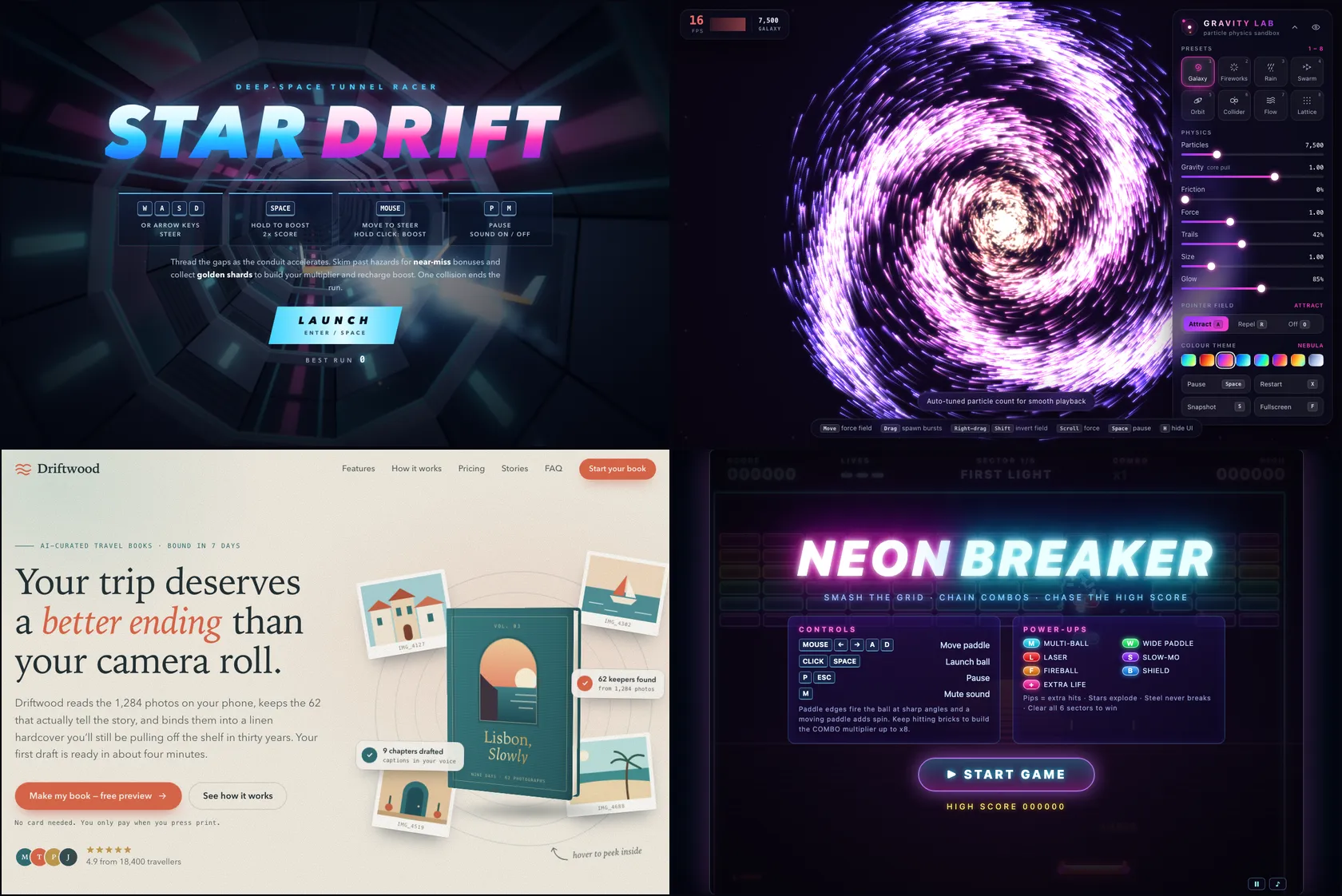
TL;DR: in Claude Fable 5.2, the effort level has a big effect on cost and response time. The same landing page cost $1.35 and took 5 min 4 s at low, and $9.09 and 37 min 34 s at max. On this brief, Fable 5.2 wrote more tokens than Fable 5.1 at every level, and about 4 times as many at high. If you work with Fable, start at medium, the default level in Claude Code, and raise the effort deliberately: on the same briefs, max cost 3 to 10 times more than low.
You can open all the outputs side by side, each with its cost, time and token count, at testingmodels.com/fable-5-2.
How we measured
The testingmodels.com site is run by Patryk Raba, the same publisher as vibecoding.inc, so these are our own tests. There, Fable 5.2 took on 21 challenges, from a landing page and a game, through a CHIP-8 emulator and a fluid simulation, to chess. We ran some of them at several effort levels, hence 41 outputs.
- One run per task and level (n=1). We ran each challenge once at a given level through the Claude Code CLI, with the --effort flag set separately for each run, without access to tools and without cherry-picking better attempts.
- The same briefs for every model. Fable 5.2 got exactly the same prompts as every model tested on testingmodels.com.
- Cost at API list prices. This is the run priced at $8 per million input tokens and $40 per million output tokens, as reported by the CLI. The tests themselves ran on a subscription, so the dollar figures are an equivalent, not a bill.
- Time and tokens. Time is wall-clock generation time. Tokens are output tokens, thinking tokens included.
- No fixes. We publish every output exactly as the model wrote it.
In total, that came to $198.48 at API list prices, 4,736,435 output tokens and 12.7 hours of generation. You'll find the full description of the method in the Testing Models methodology.
Results: cost, time and tokens at every level
One brief, five effort levels
The most complete comparison comes from the Driftwood brief, a landing page for a fictional SaaS that creates travel photo books. The harness and the prompt stay the same, and only the effort level changes:
- low: $1.35, 5 min 4 s, 33.6k tokens
- medium: $2.08, 7 min 58 s, 51.5k tokens
- high: $4.72, 18 min 38 s, 117.7k tokens
- xhigh: $9.07, 27 min 46 s, 175.2k tokens
- max: $9.09, 37 min 34 s, 226.5k tokens
At the top of the ladder, xhigh and max cost almost the same, but the max run took 37 min 34 s instead of 27 min 46 s and produced 226.5k tokens instead of 175.2k. The amount reported by the CLI also includes input-side cost, so it does not have to rise in step with output tokens.
The averages across all 41 outputs follow a similar pattern (low $1.87, high $5.20, max $9.73), but each one covers a different set of tasks, so it is better to compare the same brief.
On the same brief, max cost 3.1 to 10.3 times more than low: landing page 6.7 times, game 4.6, tool 7.6, dashboard 5.2, particles 5.9, CHIP-8 emulator 10.3, news site 4.0, digger 3.1. Time grew at roughly the same rate, by 3.2 to 11.8 times.
Fable 5.2 vs Fable 5.1 on the same brief
We also have the Driftwood brief run on Fable 5.1, level by level. The new model wrote more tokens at every level and finished later at every level:
- low: 33.6k vs 27.4k tokens (+23%), 5 min 4 s vs 4 min 53 s
- medium: 51.5k vs 26.5k (+94%), 7 min 58 s vs 4 min 55 s
- high: 117.7k vs 29.7k (+297%), 18 min 38 s vs 5 min 26 s
- xhigh: 175.2k vs 95.7k (+83%), 27 min 46 s vs 18 min
- max: 226.5k vs 144.3k (+57%), 37 min 34 s vs 30 min 16 s
The biggest gap came at high: about 4 times as many tokens and 3.4 times as much time. On other briefs where both models have an output at the same level, Fable 5.2 also always wrote more: at low 1.3 to 2.4 times as many tokens as Fable 5.1, at high 1.5 to 2.3 times, and at max the gap was the smallest (game: 216.0k vs 198.8k, dashboard: 216.3k vs 197.6k).
In dollars the picture is different and easy to misread. At low, Fable 5.2 came out cheaper ($1.35 vs $2.17) even though it wrote more tokens. The new model's rates are 20% lower: $8 and $40 per million input and output tokens, against $10 and $50 for Fable 5.1.
On top of that, the Fable 5.1 costs reported by the CLI include about $1.21 of input-side cost per run, against $0.42 for Fable 5.2. So when you compare the models, tokens matter most. We covered the new pricing and the other changes in our article on the Fable 5.2 launch.
Fable 5.2 also generates tokens faster. By our calculation (output tokens divided by wall-clock time on the Driftwood brief), the new model produces about 100 to 110 tokens per second and Fable 5.1 about 80 to 94, which makes Fable 5.2 16% to 26% faster. That is consistent with Anthropic's statement that the 5.2 models generate outputs up to 30% faster than the 5.1 versions. Wall-clock time includes overhead, so treat this as an approximation.
Faster tokens do not mean a faster answer, though: at the same level, Fable 5.2 finished later because it wrote more. Compare that with what Anthropic says in its launch announcement:
On Medium effort (the default in Claude apps and Claude Code), Fable 5.2 can accomplish challenging tasks with fewer tokens than Fable 5.1.
On our brief, in a single run, Fable 5.2 at medium wrote 51.5k tokens and Fable 5.1 wrote 26.5k, so 94% more. This is an observation, not a refutation of Anthropic's claim: one brief and one run are not enough, and a landing page is not necessarily what the company means by a challenging task. Still, if you move work from 5.1 to 5.2 without changing the level, check token usage on your own tasks instead of assuming it will go down.
What this means for your work
- Medium as the starting point. It is the default level in Claude apps and in Claude Code (per Anthropic). On the Driftwood brief it cost $2.08 and took 7 min 58 s, while high was already at $4.72 and 18 min 38 s.
- High and above is a budget decision. On the same briefs, max cost 3 to 10 times more than low, and time grew in a similar way. Raise the level when the output of a lower one does not meet your needs, not out of habit.
- On a subscription, you pay with your usage limit. The dollar figures in this article won't land on your bill, but the tokens and the time stay the same. Anthropic says that, during launch week, subscribers on eligible paid plans get one to three Fable limit resets, depending on how long they have subscribed, and that Fable can account for up to 50% of the weekly usage limit on the Pro plan and on standard Team seats. In our tests, Driftwood at max came to 226.5k output tokens, against 51.5k at medium, so expect the higher levels to bring you closer to your limit faster.
- Anthropic recommends starting with Opus 5.5. For most coding and knowledge tasks, the company recommends starting with Claude Opus 5.5, which it calls its strongest daily driver, and switching models as needed, depending on the scope and complexity of the work. Our numbers cover Fable only, so we are not verifying this advice.
What this data does not tell you
- One run. Every number comes from a single run (n=1), so repeating the same brief may produce a different cost and time.
- No quality rating. The page shows cost, time and tokens. It does not say which level made the better landing page, and we do not claim that higher effort gives a better result.
- Not everything works. The CHIP-8 emulator at low and at max throws an error on load because the model wrote malformed base64 ROM data. We publish both outputs as they were generated, without fixes.
- One run was repeated. A usage limit cut off the first attempt at the 3D game at high before any output was produced, so we ran it again. The page marks this output as generated a second time.
We leave judging the quality to you. At testingmodels.com/fable-5-2 you'll find the 41 Fable 5.2 outputs and can open low, medium, high and max side by side, exactly as the model wrote them. Before you set an effort level for good, see what you get for each step up.
Sources: Anthropic: Introducing Claude Fable 5.2 and Claude Mythos 5.2, testingmodels.com/fable-5-2, testingmodels.com/method.